Showing posts with label Enterprise & Consumer IT. Show all posts

Wednesday, November 13, 2019

API Management Market Latest Trends, Growth, Opportunities and Forecast 2026

Application program interface (API) management is a set of processes that can design, publish, document, and analyze APIs in a secure environment. Also, it can distribute, control, and analyze various APIs that link applications and data across enterprise and clouds. Organizations can guarantee that the public and internal APIs created are consumable and secure through an API management solution. The primary goal of API management is to allow enterprises to utilize or publish an API, to monitor the interface's lifecycle, and to ensure that the developers and applications using the API needs are met. Hence, the global API management market size is anticipated to significant growth during the forecast period.  API management is mainly about centralizing the control of API programming which includes analytics, access control, monetization, and developer workflows. For example, Red Hat 3scale API management solution, provides flexibility, dependability, speed, and quality. Also, an API management solution provides rate limits, access control, and usage policies at the minimum.



Increase in demand for API-led connectivity is primarily driving the growth of the API management market. In addition, businesses across the globe are implementing strategies to manage their application program interface to rapidly respond to the changes in customer demands. This is a major factor expected to boost the growth of the global API management market. Companies among various industry verticals are focusing on offering enhanced in-store or out-store experience along with customized recommendations, product support, and offers according to the gender, location, and behavior of the customer though API management solutions. These are the major factors that are expected to drive the growth of the global API management market. However, dearth of professionals required for developing and implementing API management solutions is a challenging factor that can hamper the growth of the global API management market. On the contrary, low-code platform for API development is expected to offer significant opportunities for this market.

Ask for Request Sample Report @  

The global API management market is segmented based on component, deployment, enterprise size, industry vertical, and region. Based on component, it is bifurcated into solutions and services. By solution, the market is further sub-segmented into security, API platform, API analytics. By services, the market is further sub-segmented into consulting, support and maintenance, training and education, and integration and implementation. Based on deployment, the market is categorized into cloud and on-premises. Based on enterprise size, it is classified into large enterprises and small & medium enterprises (SMEs). Based on industry vertical, it is divided into travel & transportation, media & entertainment, retail, healthcare & life sciences, IT & telecommunications, banking, financial services & insurance (BFSI), and others. Based on region, it is analyzed across North America, Europe, Asia-Pacific, and LAMEA.

KEY BENEFITS FOR STAKEHOLDERS
  • The study provides an in-depth analysis of the global API management market size along with the current trends and future estimations to elucidate the imminent investment pockets.
  • Information about key drivers, restraints, and opportunities and their impact analysis on the market size is provided.
  • Porter’s five forces analysis illustrates the potency of buyers and suppliers operating in the industry.
  • The quantitative analysis of the global API management market industry from 2018 to 2026 is provided to determine the market potential.

KEY MARKET SEGMENTS

By Component
  • Solution
  • Security
  • API Platform
  • API Analytics
  • Services
  • Consulting
  • Support and Maintenance
  • Training and Education
  • Integration and Implementation
By Deployment
  • Cloud
  • On-Premises
By Enterprise Size
  • Large Enterprises
  • Small & Medium Enterprises (SMEs)
By Industry Vertical
  • Travel & Transportation
  • Media & Entertainment
  • Retail
  • Healthcare & Life Sciences
  • IT & Telecommunications
  • Banking, Financial Services & Insurance (BFSI)
Key Players
  • CA Technologies
  • Google LLC
  • IBM Corporation
  • Microsoft Corporation
  • MuleSoft, LLC
  • Oracle Corporation
  • Red Hat, Inc.
  • SAP SE
  • Software AG
  • TIBCO Software, Inc.
  • Amazon Web Services, Inc.
Similar Reports:


Behaviour Analytics Market 2026 with Strategic Trends Growth, Revenue

Behavior analytics is the area of data analytics that focuses on providing insight into the actions of people, usually regarding online purchase. It is used in e-commerce, gaming, social media, and other applications to identify opportunities to optimize in order to realize specific business outcomes. It is based on hard data-it uses the volumes of raw data people use while they are on social media or in gaming applications. This data is collected and analyzed and then used as the basis of making certain decisions, including advertisement placement. It is used to analyze the patterns of human behavior and then apply statistical analysis and algorithms to detect variances.


Growth in adoption of cloud-based behavior, analytic solutions, and improvement of security measures in behavior analytics are the major factors that drive the growth of the behavior analytics market. In addition, rise in need for threat prevention technologies and increase in demand for real-time analytics fuel the growth of the behavior analytics market. However, the shortage of trained security professionals and lack of awareness regarding advanced insider threats hamper the growth of the behavior analytics market. Furthermore, advanced cloud-based behavior analytics solutions offer better handling of sensitive data, thus providing major opportunities for behavior analytics market growth.

Download Sample PDF Brochure @  

The behavior analytics market is segmented based on component, deployment mode, organization size, industry vertical, and region. In terms of component, the market is segmented into solution and services. The solution type is further sub-segmented into compromised credential detection solutions, insider threat detection solutions, loss prevention solutions, and others. The service segment is further sub-divided into managed services and professional services. As per deployment mode, the market is bifurcated into on-premise and cloud. In terms of organization size the market is segmented into large size organization and small and medium size organization. As per industry vertical, the market is classified into BFSI, it and telecommunication, manufacturing, healthcare, and others. Based on region, the market is analyzed across North America, Europe, Asia-Pacific, and LAMEA (Latin America, Middle East, and Africa).

KEY BENEFITS FOR STAKEHOLDERS
  • The study provides an in-depth analysis of the global behavior analytics market size along with the current trends and future estimations to elucidate the imminent investment pockets.
  • Information about key drivers, restraints, and opportunities and their impact analysis on the market size is provided.
  • Porter’s five forces analysis illustrates the potency of buyers and suppliers operating in the industry.
  • The quantitative analysis of the global behavior analytics market share from 2018 to 2026 is provided to determine the market potential

KEY MARKET SEGMENTS
By Component
  • Solution
  • Compromised Credential Detection Solutions
  • Insider Threat Detection Solutions
  • Loss Prevention Solution
  • Services
  • Professional Service
  • Managed Service
By Deployment Mode
  • On-premise
  • Cloud
By Organization Size
  • Large Size Organization
  • Small & Medium Size Organization
By Industry Vertical
  • Banking, Financial Services, and Insurance (BFSI)
  • IT & Telecommunication
  • Manufacturing
  • eHealthcar
KEY MARKET PLAYERS PROFILED IN THE REPORT
  • IBM Corporation
  • Microsoft Corporation
  • Splunk Inc.
  • Varonis Systems Inc.
  •  Exabeam Inc.
  •  Niara Inc.
  • SAP SE
  •  Oracle Corporation
  • NTT Data Corporation
  • Tibco Software Inc.
Similar Reports:


Tuesday, October 15, 2019

Image Recognition Market Research Methodology and Market Estimation by 2019-2025

Image Recognition Market by Deployment Mode (On-Premise and Cloud), Component (Hardware, Software, and Services, Industry Vertical (IT & Telecom, BFSI, Healthcare, Retail, Government, Media & Entertainment, Transportation & Logistics, Manufacturing, and Others), Technology (Object Detection, QR/Barcode Recognition, Facial Recognition, Pattern Recognition, and Optical Character Recognition), and Application (Scanning & Imaging, Security & Surveillance, Image Search, Augmented Reality, Marketing & Advertising): Global Opportunity Analysis and Industry Forecast, 2018-2025. The report offers in-depth analyses of the industry by closely monitoring the key industry trends, drivers & opportunities, top investment pockets, growth strategies, key player positioning, and competitive landscape. According to the report, the global image recognition market was pegged at $17.91 billion in 2017 and is expected to reach $86 billion by 2025, registering a CAGR of 21.8% from 2018 to 2025.

Growing popularity of media cloud services and increasing pace of technological advancements in facial recognition technology drive the growth of the global image recognition market. Moreover, surge in the number of mobile devices equipped with cameras and rise in demand for security applications and products laden with image recognition features supplement the market growth. However, high cost of installation of image recognition systems is expected to hamper the market growth. On the contrary, supportive regulations that mandate the use of image recognition products and high demand of image recognition in the healthcare industry are expected to provide lucrative opportunities to the market.
Cloud segment to be lucrative through 2025 
The cloud segment captured 55.9% of the total market share in 2017 and would maintain its dominance through the forecast period, owing to increased adoption of cloud in various industry verticals such as media & entertainment, banking, financial services, and insurance (BFSI), and government organizations. The segment is expected to grow at the fastest CAGR of 23.3% through 2025. On the other hand, the on-premise segment would grow at a steady pace during the forecast period.
Service segment to grow the fastest through 2025 
The service segment accounted for the largest share of 47.5% in 2017 and would maintain its lead through 2025, registering the fastest CAGR 23.5% from 2018 to 2025. This is attributed to the growing popularity of media cloud services and increasing demand for managed network security services. The other components discussed in the study are hardware and software.
Healthcare segment to grow the fastest CAGR through 2025 
The healthcare segment is expected to grow at the fastest CAGR of 28.4% during the forecast period, owing to the increasing adoption of image recognition along with growing demand for image recognition in clinical decision support to enhance the efficiency of pathologists, radiologists, and other image-based diagnosticians. However, the retail segment held the largest share of 22.4% in 2017, as increased adoption of image recognition in this industry leads to in-store promotion and increases consumer engagement. On the other hand, the transportation & logistics segment is expected to contribute the largest share of 17.9% through 2025. The report also discusses IT & telecom, BFSI, government, media & entertainment, manufacturing, among other industries.
Object detection segment to dominate, facial recognition to witness robust growth through 2025 
The object detection technology segment garnered 33% of the total market share in 2017 and is projected to maintain its lion's share through 2025. However, the facial recognition segment is expected to witness the fastest CAGR of 26.1% through the study period, owing to increased usage of the technology in both law enforcement and non-law enforcement applications. Moreover, the technology is widely preferred over other biometric technologies due to its non-contact process and easy deployment (using cameras and existing monitoring devices). The other technologies analyzed in the report include QR/barcode recognition, pattern recognition, and optical character recognition.
Image search segment to dominate, augmented reality segment to attain fastest growth 
The image search segment held the largest share in 2017, capturing 35.4% of the overall total market share. It is expected to maintain its lead through 2025, as this technology is increasingly used in the e-commerce sector for various applications such as visual search, product tagging, and content curation. However, the augmented reality segment is expected to grow at the fastest CAGR of 26.7% from 2018 to 2025. The other applications discussed in the report include scanning & imaging, security & surveillance, and marketing & advertising.
Asia-Pacific to grow the fastest, North America to accrue highest revenue 
In 2017, the North America contributed 46.7% of the total market share in 2017, owing to surge in the number of users of electronic gadgets and smartphones with image recognition applications. However, Asia-Pacific would manifest the fastest CAGR of 25.4% during the study period, owing to lurking threats due to terrorist attacks and growing trend towards e-governance in the region. The other regions analyzed in the report are Europe and Latin America, Middle East, and Africa (LAMEA).
Torchbearers of the Industry 
The leading companies operating in the global image recognition market include IBM Corporation, Imagga Technologies Ltd., Amazon Web Services, Inc., Qualcomm Incorporated, Google LLC, Microsoft Corporation, NEC Corporation, LTU technologies, Catchoom Technologies S.L., and Intel Corporation.
Driving factors for the market
1. Growing use of image recognition applications
2. Technological advancements in facial recognition technology
3. Growing demand for security applications and products enabled with image recognition functions
4. Supportive regulations that mandate the use of image recognition solutions
For more information about this report visit :  

Intelligent Virtual Assistant Market Application Estimates and Outlook Overview by 2014-2020

Intelligent Virtual Assistant Market report, published by Allied Market Research, forecasts that the global market is expected to garner $3.6 billion by 2020, registering a CAGR of 35.2% during the period 2015 - 2020. North America dominates the global intelligent virtual assistant market owing to the increased adoption of IVA in countries such as the U.S. However, Asia-Pacific region is expected to exhibit a faster growth over the forecast period 2015 - 2020.

The technology segment comprises speech recognition and text-to-speech technology. Speech recognition technology segment dominated the market in 2014, and is expected to dominate throughout the forecast period 2015-2020. Intelligent virtual assistant (IVA) is used in various industry verticals such as automotive, healthcare, BFSI, retail and others. Among these verticals, BFSI was the highest revenue-generating segment, accounting for 39.9% share in 2014. 
IVA solutions are widely used in the BFSI sector, owing to faster response time, improved customer handling and high customer satisfaction. However, automotive segment would witness the fastest growth during the forecast period. The growth would be driven by the fast growing in-car infotainment systems market, as IVA is an important part of these systems, which enables the vehicle driver and passengers, to surf the internet, navigate and make calls through speech recognition technology.
Further, theIVA market based on geography is bifurcated into North America, Europe, Asia-Pacific and LAMEA. North America dominated the global intelligent virtual assistant (IVA) market, accounting for 39.5% market share in 2014. The region would maintain its dominance during the forecast period. However, Asia- Pacific would witness the highest CAGR of 38.97% during the same period.
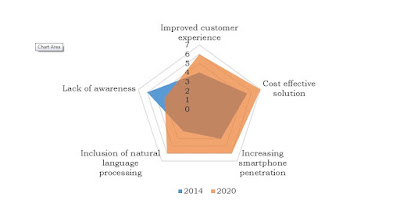
Driving factors for the market
1 Improved customer experience
2 Cost effective solution
3 Increasing smartphone penetration
Market Restraints and Opportunities
1 Lack of awareness
2 Inclusion of natural language processing
Intelligent Virtual Assistant Market Key Segments:
The global IVA market is segmented based on technology, vertical and geography.
By Technology
  • Text-to-Speech
  •  Speech Recognition

By Vertical
  •  Automotive
  •   Healthcare
  •  BFSI
  •  Retail (e-commerce)

By Geography
  •  North America
  •  Europe
  •  Asia-Pacific
  •  LAMEA

Key Players
  • Next IT Corporation
  •  Nuance Communications, Inc.
  •  IntelliResponse Systems, Inc.
  •  CodeBaby Corporation
  •  Creative Virtual Ltd.
  •  Speaktoit, Inc.
  •  Artificial Solutions
  •  eGain Corporation
  •  CX Company
  •  Anboto Group

Similar Reports:

Monday, September 30, 2019

Consumer Cloud Storage Services Market Rising Trends, Demand and Technology Growth 2019 to 2026

Consumer Cloud Storage Services Market Outlook: 2026

Consumer cloud storage is a cloud computing model in which data is stored on remote servers that can be accessed from the internet or cloud. It is maintained, operated, and managed by a cloud storage service provider on a storage server that is built on virtualization techniques. Consumer cloud storage services allow users to store, download, edit, and share their media content such as videos, images, documents, and various other files on the cloud. The consumer cloud storage supports more than 270 file formats and more than 100 languages. It facilitates working with personal devices such as smartphones, tablets, notebooks, and others. It is a remote server which is maintained, managed, and operated by cloud storage providers. It is basically a virtual mode of data storage. The data which is stored on the consumer cloud can be accessed and shared across devices through internet by the consumers. This provides a significant growth in the consumer cloud storage services market size.


Increase in the number of mobile devices and rise in adoption & penetration of the internet are the major factors driving the growth of the consumer cloud storage services market. In addition, growth in demand for consumer cloud storage services for data storage as well as advancements in mobile communication technologies fuel the growth of the consumer cloud storage services market. However, lack of network bandwidth and resistance of customers for adoption of new technology and data security hamper the growth of the market. Furthermore, increase in need for technologically advanced storage solutions and high rate of adoption among the SME’s are anticipated to provide major opportunities in the market.

Request TOC/ Sample Report @ 

The consumer cloud storage services market is segmented by storage tier, user age, and region. In terms of storage tier, the market is bifurcated into 50 GB-999 GB, 1 TB - 9.99 TB, and >= 10 TB. In terms of user age, the market is segmented into <18 years, 18-40 years, and >40 years. Based on region, it is analyzed across North America, Europe, Asia-Pacific, and LAMEA.


The key players profiled in the consumer cloud storage services market analysis are IBM Corporation, Oracle Corporation, Microsoft Corporation, Google (Alphabet Inc.), Apple Inc., Dropbox Inc., Sync.com Inc., Amazon .com Inc., pCloud AG, Hubic (OVH), and Mediafire.


KEY BENEFITS FOR STAKEHOLDERS
  • The study provides an in-depth analysis of the global consumer cloud storage services market size along with the current trends and future estimations to elucidate the imminent investment pockets.
  • Information about key drivers, restraints, and opportunities and their impact analysis on the market size is provided.
  • Porter’s five forces analysis illustrates the potency of buyers and suppliers operating in the industry.
  • The quantitative analysis of the global consumer cloud storage services industry from 2018 to 2026 is provided to determine the market potential.

KEY MARKET SEGMENTS

By Storage Tier
  • 50 GB-999 GB
  • 1 TB - 9.99 TB
  • >= 10 TB
By User Age
  • <18 years
  • 18-40 years
  • >40 years